By: Bob Zeglovitch
Note: This post concerns the Chinese Chan (Zen) poem Harmony of Difference and Equality. The text of the poem can be found here. If you are new to the poem, you can find some background information in the blog post on this site dated February 3, 2025. The quickest way to find that is to scroll to the bottom of this post and click on the “tag” for Harmony of Difference and Equality. You’ll need to scroll to the second post. You can then click on the same tag at the bottom of that post to find your way back.
Images of light and dark are prominent in the 8th century Chinese Chan Master Shitou’s Harmony of Difference and Equality. He writes: “The spiritual source shines clear in the light; the branching streams flow on in the dark.” Further: “Refined and common speech come together in the dark; clear and murky phrases are distinguished in the light.” And finally: “In the light there is darkness, but don’t take it as darkness; In the dark there is light; but don’t see it as light; Light and dark oppose one another like the front and back foot in walking.” At Just Show Up, as we explore these central images of light and dark, we are taking a path of circumambulation. This is a slow, circling (or spiraling) approach rather than a linear one. This manner of framing inquiry, or path, has broad implications for dharma practice and life.
The word circumambulation comes from the Latin circum (around) and ambulatus (to walk). In religions around the world, it is used to signify walking around a temple, altar, image of a deity, or other sacred site, either in a clockwise or counterclockwise direction. At the customary sites of pilgrimage in northern India, Buddhist pilgrims walk around the stupa in Sarnath that houses relics of the Buddha and commemorates the place of his first teaching following his awakening; the Mahabodhi Temple and Bodhi Tree (or its great great grandchild!) under which the Buddha was enlightened in Bodh Gaya: and a statute of the reclining Buddha in Kushinagara, where he died. There is a quality in this ritual of remembering, making sacred and paying devotion, and engaging in mindful embodied attention. The ritualized experience of walking around a circle in this way may also lead us through different levels of consciousness. In a traditional Soto Zen temple, the teacher does jundo at the beginning of the day, in which she or he walks around the seated students in a circular round, observing and acknowledging the students and creating a circle of protection. Zen meditators typically do kinhin, or slow walking meditation, in a clockwise circular path around the zendo. There are multiple meanings here—a journey through different levels of consciousness, remembering, an honoring and sacralizing (making sacred), acknowledgment and observation, embodied meditation, and creating a symbolic protected zone in which deep transformation can take place.
The shape that is the basis of circumambulation, the circle, is a universal symbol that has a variety of deep cultural, religious, and psychological associations and meanings. As an example, see the passage from Black Elk on the Readings page of this website dated May 30, 2026. The circle represents wholeness, unity, and integration. In the Zen tradition, there is the familiar circular calligraphy form of the ensō, which is associated with enlightenment, emptiness, wholeness and nonduality. The contemporary Zen calligrapher and scholar Kaz Tanahashi describes it as representing, among other things, the completeness of each moment. He also says that the circle is going beyond intellectual divisions, which feels very much in the spirit of the Harmony of Difference and Sameness. Tanahashi discusses the ensō in a short video you can find here. Zen Master Dogen, the founder of the Soto Zen school in Japan, invokes the circle to express continuous practice: “Between aspiration, practice, enlightenment, and nirvana, there is not a moment’s gap: continuous practice is the circle of the way.”
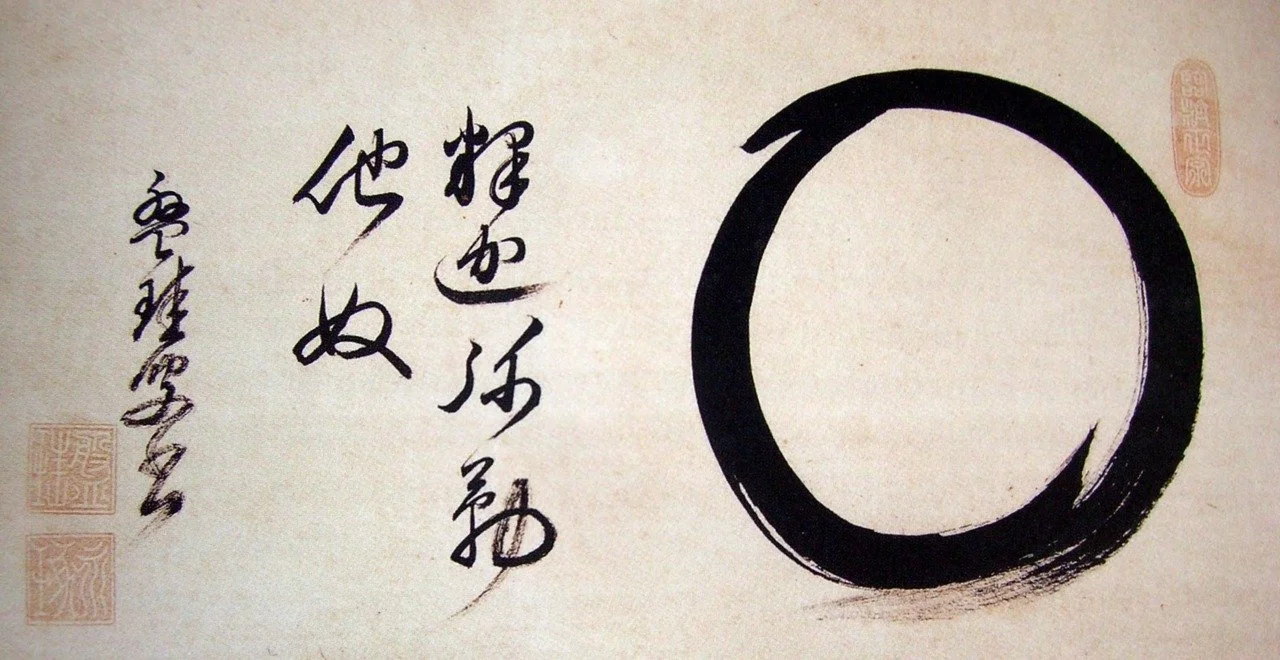
By Bankei Yōtaku - Internet, Public Domain, https://commons.wikimedia.org/w/index.php?curid=33616083
We can certainly experience circle as wholeness and integration. We might also, however, have the experience of “going around in circles”, finding ourselves stuck in a kind of feedback loop where we keep repeating our habit patterns. If we can manage to stay awake while circling, however, we may be able to “see” with increasing depth, nuance, and clarity. I’ve heard Sayadaw Vivekananda, a master teacher in the Burmese Theravada Mahasi Sayadaw/Sayadaw U Pandita lineage, say that we may have to directly return thousands of times to an object of mind (such as the rise or fall of the abdomen with breath), before we have true dharma insight into the three characteristics of dukkha (suffering), impermanence, and not-self. This is a kind of circling, returning again and again to the same point to enable a full experiential “seeing.”
We might experience a similar circling process in a psychotherapeutic setting, where we tell the same personal narrative a number of times. While it can seem like we are just repeating ourselves, each new telling is potentially enhanced by the learnings and experiences since the last telling, a particular component may stand out in a new way, and we may benefit from a fresh and more understanding ear from the listener—who has also been accumulating insight to be shared through the circling process.
Another universal shape that can serve to animate our understanding and experience of a circumambulating path of dharma practice and inquiry is the spiral. The cultural anthropologist Angeles Arrien, in her book Signs of Life: The Five Universal Shapes and How to Use Them, writes: “The spiral symbolizes the process of growth and evolution. It is a process of coming to the same point again and again, but at a different level, so that everything is seen in a new light. The result is a new perspective on issues, people, and places.” The noted Jungian analyst and scholar Anthony Stevens, in his book Ariadne’s Clue: A Guide to the Symbols of Humankind, says that the spiral is an “extremely ancient, complex, and ubiquitous symbol representing the creative power of the universe emanating from the navel, the center, or omphalos…which shares in the symbolism of the labyrinth.” Stevens adds that the double spiral represents “evolution and involution, the basic rhythms of nature, Yin and Yang, feminine and masculine, yoni and lingam, shakta and shakti.” A connection to the Harmony of Difference and Equality emerges here. The poem plays on Taoist themes of light (yang/masculine) and dark (yin/feminine). Perhaps Shitou’s text itself can be seen as a double spiral that expresses the mysterious interplay of the phenomenal world of difference and the absolute, empty and interdependent nature of the universe. We can wonder: what is at the center of this spiral? For more on the symbolism of the spiral, see the entry by that name on the Readings page of this website dated May 30, 2026.
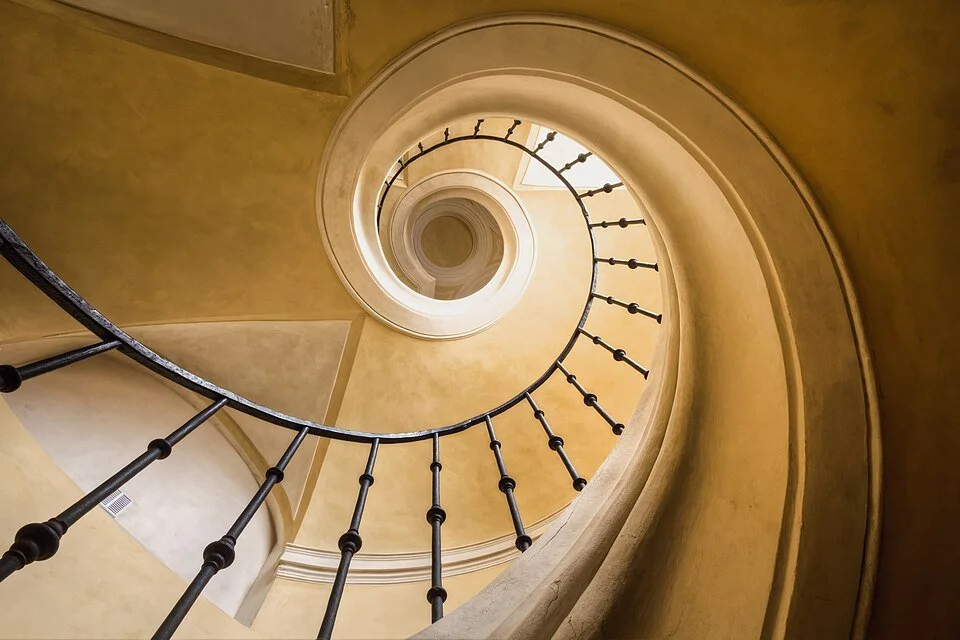
Brad Hammonds, CC BY 2.0 <https://creativecommons.org/licenses/by/2.0>, via Wikimedia Commons
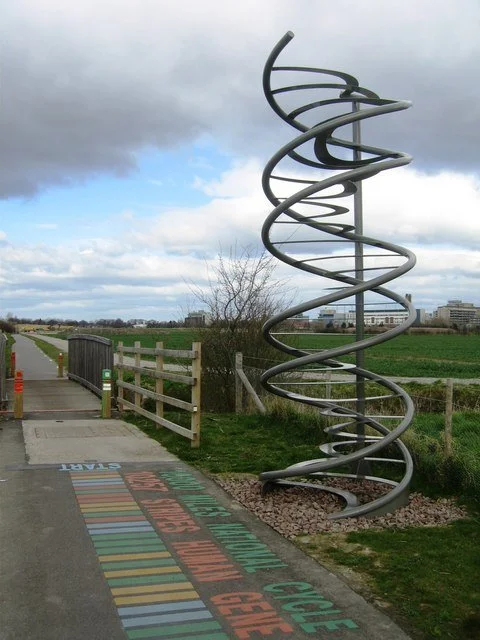
Sebastian Ballard, Creative Commons Attribution Share-alike license 2.0
We can encounter the symbol of spiral as descending into the depths, or darkness—or as ascending into clarity, or light. We may need at various times to spiral in one direction or the other. As we spiral around the symbols of light and dark, our consciousness can expand and hold more complexity, contradiction, and integration.
I’m making a connection in our exploration of these symbols to the use of circumambulation in Jungian work. In Jungian analysis, the analyst and analysand circumambulate around images from dreams or active imagination, returning to the image repeatedly from different vantage points, coming up with different associations and amplifications from personal memory, culture, language, and myth. In this method, there is no need to jump to a quick rational understanding of what is being circled around. Different possibilities are allowed to surface and are held in awareness. Multiple layers of meanings can coexist. The inquirers can return again and again to the image, trusting that deeper levels of understanding can emerge slowly upon revisiting. There is a sense of play here. Fixed ideas and concepts are loosened, allowing for new and different possibilities. A sense of wonder about an image or a symbol can emerge, and there need not be any final fixed answer. This is a process that expands our consciousness. We can bring this same sensibility to dharma practice.
Jung described the circumambulation process like this:
“ The way to the goal seems chaotic and interminable at first, and only gradually do the signs increase that it is leading anywhere. The way is not straight but appears to go round in circles. More accurate knowledge has proved it to go in spirals…We might draw a parallel between such spiral courses and the processes of growth in plants; in fact the plant motif (tree, flower, etc.) frequently recurs in these dreams and fantasies and is also spontaneously drawn or painted. In alchemy the tree is the symbol of Hermetic philosophy.”
This feels like an apt description of Zen practice…and of making our way in life in general. The way is not straight, a beeline from here to there, checking off some boxes and tallying up our achievements. Instead, it is slow, sometimes painful, sometimes confusing, circling around what seems to be the same territory—and yet, if we patiently stay with the process, continue to be curious and inquire, and trust, openings can occur in their own time and manner. I find Jung’s connection of the spiral to the plant motif to be particularly encouraging, reminding us that our unfolding is a natural process that we can relax into. And of course, the Buddha was enlightened at the foot of a tree!
There is more than one “dharma” understanding of what Shitou means by light and dark in this poem. Shitou himself uses the image of light in perhaps a different way than in the Harmony of Difference and Equality--in his other famous text the Song of the Grass Roof Hermitage (“Turn around the light to shine within, then just return.”). Many Buddhist texts across time and in different traditions refer to light and dark, and having an appreciation of the diverse and often subtle ways in which these symbols have been used throughout that history is important background for appreciating Shitou’s poem. Going straight to Shitou’s apparent meaning, as articulated by learned commentators, could result in a shallow and merely intellectual understanding on our part. Light and dark are primordial and powerful symbols, and a circumambulation approach allows us to uncover their richness and diversity, as well as our instinctual/emotional responses. In our inquiry, we are allowing ourselves to gradually find our own personal associations with the symbols, as well as exploring what they have represented in various cultural traditions. When we ultimately come to the dharma explanations for Shitou’s text, we will hopefully have a more complete body/heart/mind response and a more textured and nuanced appreciation.
On a personal note, immediately after my partner Ava died in January of this year, we circled her body clockwise three times, once while I rang a bell and once while I shook a ceremonial rattle. I had in mind the Buddhist practice of circumambulating, but it also just felt instinctual and right to do this—and it certainly had the functions of making sacred and honoring; remembering a powerful and transformational moment as it was happening; creating a circle of protection within which the immediate experience of grief could be held; and paying mindful attention in an embodied way at a time of the awesome passage between life and death. This symbolic ritual of circumambulation has an aliveness to it that for me is not limited to the time during which it literally occurred. It lives on in psyche—resonant, available and a source of healing.
I hope to follow up this post with more on what our sangha’s collective investigation of the symbols of light and dark reveals. Our conversations, which are just beginning, have already made clear that these symbols are filled with resonance and potency.
Note: This post expands on two dharma talks given on May 15 and May 22, 2026, which can be found on the Dharma Talks page of this website.